Gym Ball Abdominal Exercises: Best Stability Ball Exercises for a Strong Core
If you want to build a stronger core, improve balance, and make your abdominal workout more challenging, gym ball abdominal exercises are an excellent choice. A gym ball, also known as a stability ball, Swiss ball, or exercise ball, creates an unstable surface that requires your abdominal muscles to work harder to keep your body balanced and controlled.
Unlike traditional floor exercises, stability ball ab exercises can involve several muscles at the same time. Depending on the exercise, you may work your rectus abdominis, obliques, transverse abdominis, hip flexors, lower back, and other core stabilizer muscles. This makes an exercise ball core workout useful for beginners, intermediate trainees, and experienced gym-goers.
In this complete guide, you will learn how to perform the best gym ball abdominal exercises, which muscles they target, how to create a stability ball ab workout, common mistakes to avoid, and ways to make your exercises more challenging as your core becomes stronger.
What Are Gym Ball Abdominal Exercises?
Gym ball abdominal exercises are core exercises performed with a fitness ball or stability ball. The ball can support your back, legs, arms, or hips depending on the movement. Because the ball can move slightly underneath your body, your muscles must constantly make small adjustments to maintain stability.
This additional balance challenge is one reason why Swiss ball exercises are popular in gyms and home workouts. Instead of simply moving your torso up and down, you have to control your entire body throughout the exercise.
Gym ball exercises can be used for different fitness goals, including:
- Building core strength
- Improving balance and stability
- Increasing abdominal muscle endurance
- Improving body control
- Adding variety to a core workout
- Supporting functional fitness
Why Use a Gym Ball for Abdominal Training?
A stability ball can make familiar abdominal exercises more challenging. When you perform a movement on an unstable surface, your core muscles have to help stabilize your body while you complete the exercise.
1. It Challenges Core Stability
Core stability is your body’s ability to control and support the spine and pelvis during movement. When you perform an exercise ball core workout, you need to maintain your position while the ball moves slightly beneath you.
This can make simple movements such as crunches and planks feel more demanding than their traditional versions.
2. It Improves Balance
Balance is an important part of many stability ball exercises. Your abdominal muscles work together with your back, hips, and other muscles to help keep your body in the correct position.
With regular practice, you can become more comfortable controlling your body during exercises that require balance.
3. It Adds Variety to Your Ab Workout
If you always perform the same floor crunches and sit-ups, your workout can become repetitive. Adding a gym ball allows you to introduce different movements and training positions.
You can use the ball for crunches, planks, knee tucks, rollouts, leg exercises, and several other core-strengthening movements.
Best Gym Ball Abdominal Exercises
There are many ways to use an exercise ball for abs. Beginners should start with simple movements and focus on proper form before progressing to more difficult exercises.
1. Stability Ball Crunch
The stability ball crunch is one of the best starting exercises for anyone new to gym ball abdominal exercises. The ball supports your back while allowing your abdominal muscles to work through a controlled range of motion.
How to Perform a Stability Ball Crunch
- Sit on the exercise ball with both feet firmly on the floor.
- Slowly walk your feet forward until your lower and middle back are supported by the ball.
- Keep your knees bent and your feet approximately hip-width apart.
- Place your hands lightly behind your head or across your chest.
- Brace your abdominal muscles.
- Slowly lift your upper body by contracting your abs.
- Pause briefly at the top of the movement.
- Lower your upper body slowly back onto the ball.
Aim for 10 to 15 controlled repetitions per set. Avoid pulling your neck forward with your hands. Your abdominal muscles should control the movement.
Muscles Worked
The stability ball crunch primarily targets the rectus abdominis, which is the muscle commonly associated with the six-pack appearance. Your deeper core muscles also help stabilize your body while you perform the exercise.
2. Stability Ball Plank
The stability ball plank is an excellent exercise for developing core stability. Unlike a traditional plank, the ball introduces an unstable surface that requires greater body control.
How to Perform a Stability Ball Plank
- Place your forearms on top of the stability ball.
- Extend your legs behind you.
- Keep your feet firmly on the floor.
- Lift your hips so your body forms a relatively straight line.
- Tighten your abdominal muscles.
- Keep your head and neck in a neutral position.
- Hold the position while breathing normally.
Beginners can start with 15 to 20 seconds. As your core becomes stronger, gradually increase the duration to 30, 40, or more seconds while maintaining good form.
3. Gym Ball Knee Tuck
The gym ball knee tuck is a more dynamic stability ball core exercise. It combines a plank position with controlled knee movement and can strongly challenge the abdominal muscles.
How to Perform a Gym Ball Knee Tuck
- Start in a high plank position with your hands on the floor.
- Place your feet or lower legs on the stability ball.
- Keep your arms straight and your hands underneath your shoulders.
- Brace your core before beginning the movement.
- Slowly bend your knees and bring them toward your chest.
- Allow the ball to roll forward under your legs.
- Extend your legs back to the starting position.
Start with 6 to 10 repetitions. Keep the movement slow and controlled instead of using momentum.
Gym Ball Abdominal Exercises for Beginners
If you are new to core training, you do not need to start with advanced stability ball exercises. Learning basic movements correctly will help you develop the strength and balance needed for more challenging exercises later.
Beginner-Friendly Exercise Ball Core Routine
- Stability ball crunch: 10–12 repetitions
- Stability ball plank: 15–20 seconds
- Gym ball knee tuck: 6–8 repetitions
- Rest: 30–60 seconds
Complete 2 rounds at first. If you can perform every exercise with good technique and without excessive fatigue, you can gradually progress to 3 rounds.
Important Tips for Your First Gym Ball Ab Workout
When starting an exercise ball abdominal workout, technique should be more important than the number of repetitions you complete.
Keep Your Core Engaged
Before each repetition, gently brace your abdominal muscles. Think about keeping your torso controlled rather than allowing the ball to move you around.
Move Slowly
Slow repetitions can help you maintain control and understand how your abdominal muscles are working. Avoid bouncing on the ball or using momentum to complete repetitions.
Keep Your Feet Stable
Your feet provide an important foundation during many gym ball exercises. Keep them firmly planted on the floor when required, especially during stability ball crunches.
Choose the Correct Ball Size
Your gym ball should be large enough to allow you to maintain a comfortable and controlled position. When sitting on the ball, your feet should be able to reach the floor securely and your knees should be comfortably bent.
Always follow the manufacturer’s recommendations for ball size, inflation, and maximum user weight.
Can Gym Ball Exercises Strengthen Your Abs?
Yes, gym ball exercises can be an effective part of an abdominal strengthening program. The instability of the ball requires your core muscles to help control your body while you perform different movements.
However, getting stronger abs requires consistency. Performing one workout occasionally is unlikely to produce significant changes. A regular exercise routine combined with appropriate nutrition, recovery, and full-body strength training is a better approach.
It is also important to understand that abdominal exercises strengthen your core but cannot specifically remove fat from your stomach. If your goal is visible abdominal definition, overall body-fat management is also important.
What Muscles Do Gym Ball Abdominal Exercises Work?
Different stability ball exercises target different areas of the core. Understanding these muscles can help you create a more balanced workout.
Rectus Abdominis
The rectus abdominis runs along the front of the abdomen. Crunching movements and other exercises that involve controlled trunk flexion can target this muscle.
Obliques
The oblique muscles are located along the sides of the abdomen. They help with rotation, side bending, and stabilization of the torso.
Transverse Abdominis
The transverse abdominis is a deeper abdominal muscle that contributes to core stability. Exercises that require you to brace your torso can involve this muscle.
Hip Flexors
Some gym ball abdominal movements also involve the hip flexors, especially exercises that include repeated leg or knee movement.
For the best results, your core workout should include different movement patterns rather than relying on only one exercise.
More Effective Gym Ball Abdominal Exercises
Once you are comfortable with basic stability ball exercises, you can add more movements to your routine. These gym ball abdominal exercises can challenge your core from different angles while also improving balance, coordination, and body control.
4. Stability Ball Pike
The stability ball pike is an advanced exercise that requires strong core stability and good upper-body control. It works your abdominal muscles while your hands support your body on the floor.
How to Perform the Stability Ball Pike
- Start in a high plank position.
- Place your feet on top of the stability ball.
- Keep your hands directly underneath your shoulders.
- Brace your abdominal muscles.
- Keep your legs as straight as comfortably possible.
- Lift your hips toward the ceiling.
- Bring the ball closer toward your upper body.
- Pause briefly at the top.
- Slowly lower your hips back to the starting position.
Start with 5 to 8 repetitions. This is a demanding exercise, so beginners should first develop enough strength with planks and knee tucks.
5. Stability Ball Dead Bug
The stability ball dead bug is a useful core stability exercise that teaches you how to keep your torso controlled while your arms and legs move. It can be included in a beginner or intermediate exercise ball core workout.
How to Perform a Stability Ball Dead Bug
- Lie on your back on a comfortable exercise mat.
- Lift your knees and hold the gym ball between your knees and hands.
- Keep your lower back controlled against the floor.
- Brace your abdominal muscles.
- Slowly extend one arm and the opposite leg.
- Keep the ball controlled with the opposite hand and leg.
- Return to the starting position.
- Repeat on the opposite side.
Perform 6 to 10 repetitions per side. Focus on maintaining control instead of extending your limbs farther than you can manage.
6. Stability Ball Rollout
The stability ball rollout is an excellent exercise for people who want to make their core workout more challenging. It requires the abdominal muscles to resist excessive extension as the ball moves away from your body.
How to Perform a Stability Ball Rollout
- Kneel on an exercise mat.
- Place your forearms on top of the gym ball.
- Keep your elbows comfortable and stable on the ball.
- Tighten your abdominal muscles.
- Slowly roll the ball forward.
- Keep your spine controlled as you extend your body.
- Move only as far as you can maintain proper form.
- Pull the ball back toward your knees.
Try 8 to 12 repetitions. If your lower back begins to arch excessively, reduce the range of motion.
7. Gym Ball Mountain Climbers
Gym ball mountain climbers combine core training with a faster movement pattern. Because your hands are positioned on an unstable surface, your abdominal muscles have to work to keep your body stable.
How to Perform Gym Ball Mountain Climbers
- Place your hands securely on the stability ball.
- Extend both legs behind you into a plank position.
- Keep your abdominal muscles tight.
- Bring one knee toward your chest.
- Return that leg to the starting position.
- Bring the opposite knee forward.
- Continue alternating your legs.
Beginners can perform the exercise slowly for 10 to 16 total repetitions. As your coordination improves, you can gradually increase the pace.
8. Stability Ball Reverse Crunch
The stability ball reverse crunch is another useful exercise for your abdominal workout with an exercise ball. It involves controlled movement of your hips and legs while your core remains engaged.
How to Perform a Stability Ball Reverse Crunch
- Lie flat on your back on an exercise mat.
- Place your lower legs on top of the stability ball.
- Bend your knees comfortably.
- Keep your arms beside your body.
- Brace your abdominal muscles.
- Gently lift your hips from the floor.
- Move the ball slightly toward your upper body.
- Lower your hips slowly.
Complete 10 to 15 repetitions with controlled movement. Avoid swinging your legs to create momentum.
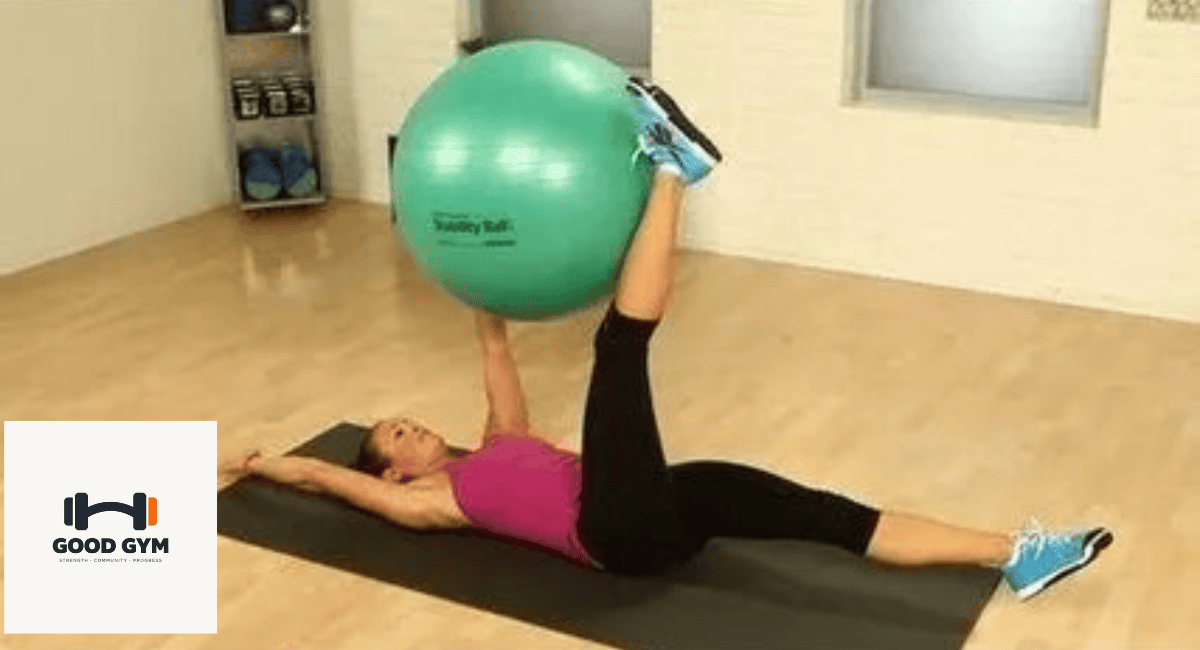
9. Stability Ball Leg Lift
Stability ball leg lifts can add variety to your core workout while challenging your abdominal muscles and hip flexors. This movement should be performed slowly to maintain control of your lower back.
How to Perform a Stability Ball Leg Lift
- Lie on your back on a mat.
- Hold the stability ball securely between your lower legs.
- Place your arms beside your body.
- Brace your core.
- Lift your legs while keeping the ball secure.
- Raise the ball toward a comfortable height.
- Slowly lower your legs toward the floor.
- Stop before your lower back loses control.
Perform 8 to 12 repetitions. You do not need to lower the ball all the way to the floor if doing so causes your back to arch.
Rotational Gym Ball Abdominal Exercises
Your core is responsible for more than bending your torso forward. It also helps control rotation and side-to-side movement. Adding rotational stability ball exercises can therefore make your workout more balanced.
10. Stability Ball Russian Twist
The stability ball Russian twist is designed to challenge the abdominal muscles and obliques through controlled rotation.
How to Perform a Stability Ball Russian Twist
- Sit on the stability ball.
- Slowly walk your feet forward.
- Lower your upper back onto the ball.
- Keep your knees bent and feet firmly planted.
- Hold your hands together in front of your chest.
- Brace your abdominal muscles.
- Rotate your torso slowly toward one side.
- Return to the center.
- Rotate toward the opposite side.
Perform 8 to 12 repetitions per side. Keep the movement controlled and avoid twisting rapidly.
11. Stability Ball Bicycle Crunch
The stability ball bicycle crunch adds an instability challenge to the traditional bicycle crunch. It can target the rectus abdominis and oblique muscles.
How to Perform It
- Position your upper back on the stability ball.
- Keep both feet firmly on the floor.
- Place your hands lightly behind your head.
- Brace your core.
- Lift one knee toward your torso.
- Rotate your upper body toward that knee with the opposite elbow.
- Return to the center.
- Switch sides.
Try 8 to 12 repetitions per side. Do not pull your head or neck forward with your hands.
12. Stability Ball Side Crunch
The stability ball side crunch is useful for targeting the muscles along the sides of your abdomen. These muscles help control side bending and rotation.
How to Perform a Stability Ball Side Crunch
- Position your side over the stability ball.
- Place your feet firmly on the floor for support.
- Keep your body stable.
- Place one hand behind your head.
- Slowly bend your torso sideways.
- Contract your abdominal muscles.
- Return to the starting position.
Perform 10 to 15 repetitions per side. Move through a comfortable range of motion and avoid rushing the exercise.
Advanced Gym Ball Core Exercises
Advanced stability ball exercises should only be introduced after you can comfortably perform basic core movements. These exercises require greater balance, strength, and coordination.
13. Stability Ball Toe Touch
The stability ball toe touch combines upper- and lower-body movement to create a challenging abdominal exercise.
How to Perform It
- Lie on your back on an exercise mat.
- Hold the gym ball above your chest with both hands.
- Raise your legs toward the ceiling.
- Brace your abdominal muscles.
- Lift your shoulders from the floor.
- Reach the ball toward your feet.
- Pause briefly at the top.
- Lower your shoulders slowly.
Start with 8 to 12 repetitions and focus on smooth movement.
14. Stability Ball V-Sit
The stability ball V-sit is an advanced core movement that challenges your balance while keeping your abdominal muscles under tension.
How to Perform It
- Sit on the floor with the gym ball nearby.
- Brace your abdominal muscles.
- Lift your legs from the floor.
- Raise your upper body into a V-shaped position.
- Hold the ball in your hands if you can maintain balance.
- Keep your movements controlled.
- Slowly return to the starting position.
If this exercise is too difficult, practice a regular V-sit without the ball first.
15. Stability Ball Plank With Shoulder Tap
The stability ball plank with shoulder tap combines core stability with controlled upper-body movement. It can be especially challenging because you must prevent your hips from rotating while one hand leaves the ball.
How to Perform It
- Place both hands on the stability ball.
- Extend your legs behind you.
- Position your feet slightly wider for better balance.
- Brace your abdominal muscles.
- Lift one hand and gently tap the opposite shoulder.
- Return your hand to the ball.
- Repeat with the other hand.
Start with 6 to 10 taps per side. Keep your hips as stable as possible throughout the movement.
How to Build an Effective Stability Ball Ab Workout
You do not need to perform all 15 exercises in one session. A better approach is to select a few movements that challenge different functions of the core.
For example, you can combine a crunching movement, a stability exercise, a rotational exercise, and a dynamic movement.
Example Gym Ball Ab Workout
- Stability ball crunch: 12 repetitions
- Stability ball plank: 20–30 seconds
- Gym ball knee tuck: 8 repetitions
- Russian twist: 10 repetitions per side
- Stability ball reverse crunch: 12 repetitions
Rest for approximately 30 to 60 seconds between exercises. Complete 2 to 3 rounds depending on your fitness level.
How to Progress Your Gym Ball Abdominal Workout
As your abdominal strength improves, your current workout may become easier. Instead of immediately moving to very advanced exercises, increase the challenge gradually.
Increase Repetitions
If you can comfortably perform all repetitions with proper form, add a few repetitions to the set.
Increase Plank Time
For stability ball planks, gradually increase your hold time. For example, you can progress from 15 seconds to 20 seconds and then to 30 seconds.
Improve Your Range of Motion
Controlled range of motion can make an exercise more challenging without requiring additional weight. Always stay within a range where you can maintain good posture.
Progress to More Difficult Exercises
Once basic stability ball crunches, planks, and dead bugs become comfortable, you can progress to knee tucks, rollouts, pikes, and other advanced core exercises.
Gym Ball Abdominal Exercises for Different Fitness Levels
One of the biggest advantages of gym ball abdominal exercises is that you can adjust them according to your fitness level. A beginner can start with simple stability ball movements, while an experienced trainee can use advanced exercises that require greater balance and core control.
The key is to choose exercises that allow you to maintain proper form. You should feel your core working without losing control of your spine, hips, or breathing.
Beginner Stability Ball Ab Workout
If you are new to exercise ball core training, start with a short workout containing basic movements. The goal is to learn how to stabilize your body before adding more difficult exercises.
- Stability ball crunch: 10–12 repetitions
- Ball dead bug: 6–8 repetitions per side
- Stability ball plank: 15–20 seconds
- Stability ball reverse crunch: 8–10 repetitions
Complete 2 rounds and rest for 30 to 60 seconds between exercises. As your strength improves, you can increase the number of rounds.
Intermediate Exercise Ball Ab Workout
An intermediate routine can include more dynamic stability ball exercises. These movements require greater coordination and abdominal strength.
- Stability ball crunch: 15 repetitions
- Gym ball knee tuck: 8–10 repetitions
- Russian twist: 10 repetitions per side
- Stability ball plank: 30 seconds
- Ball reverse crunch: 12 repetitions
Complete 2 to 3 rounds. Maintain controlled movement throughout the workout rather than trying to complete the exercises as quickly as possible.
Advanced Stability Ball Core Workout
Advanced trainees can combine stability, dynamic movement, and rotational exercises to create a challenging core workout.
- Stability ball pike: 6–8 repetitions
- Gym ball knee tuck: 10–12 repetitions
- Stability ball rollout: 8–10 repetitions
- Mountain climbers: 16–20 total repetitions
- Plank shoulder taps: 10–12 total repetitions
- Stability ball bicycle crunch: 10 repetitions per side
Complete 2 to 4 rounds depending on your training experience and recovery ability. If your form starts to break down, stop the set rather than forcing additional repetitions.
Benefits of Gym Ball Abdominal Exercises
A consistent stability ball workout can provide several benefits when it is included as part of a balanced fitness program.
1. Better Core Strength
Your core muscles help stabilize your body during exercise and everyday movements. Gym ball ab exercises challenge these muscles while you maintain balance and control.
Exercises such as stability ball planks, rollouts, knee tucks, and crunches can help develop stronger abdominal muscles when performed consistently.
2. Improved Core Stability
Core strength and core stability are related but are not exactly the same. Strength involves the ability of your muscles to produce force, while stability involves controlling your body and maintaining proper alignment.
Because the exercise ball creates an unstable surface, many stability ball exercises require you to control small changes in your position.
3. Better Balance and Coordination
Balancing on a gym ball requires coordination between your abdominal muscles, hips, back, shoulders, and legs. Regular practice can help you become more comfortable with exercises that require body control.
4. Greater Exercise Variety
A gym ball allows you to perform many different core exercises without needing a large collection of equipment. You can use one ball for crunches, planks, knee tucks, rollouts, twists, and leg exercises.
5. Full-Body Muscle Involvement
Although the main goal of an abdominal workout is to train the core, many gym ball exercises also involve other muscles. Depending on the movement, your glutes, shoulders, chest, legs, and lower back may also contribute to stability.
Gym Ball Exercises for the Upper and Lower Abs
It is common to hear people describe exercises as targeting the “upper abs” or “lower abs.” In reality, the abdominal muscles work together, although different exercises can emphasize different movement patterns.
Exercises That Emphasize Trunk Flexion
Movements such as stability ball crunches involve bringing your torso into a controlled flexion movement. These exercises strongly involve the rectus abdominis.
- Stability ball crunch
- Stability ball toe touch
- Stability ball bicycle crunch
Exercises That Emphasize Hip and Leg Movement
Exercises involving your legs and pelvis can place a greater demand on your lower abdominal region and hip flexors while requiring your core to stabilize your body.
- Stability ball reverse crunch
- Gym ball knee tuck
- Stability ball leg lift
Gym Ball Exercises for Obliques
Your oblique muscles are located on the sides of your abdomen. They contribute to rotation, side bending, and stabilization of your torso.
If you want to include more oblique-focused movements in your gym ball core workout, consider exercises such as:
- Stability ball Russian twists
- Stability ball side crunches
- Stability ball bicycle crunches
- Stability ball plank shoulder taps
Perform these exercises slowly and focus on controlled rotation. Avoid using excessive momentum because it can make the exercise less effective and harder to control.
How Many Gym Ball Abdominal Exercises Should You Do?
You do not need to perform every stability ball abdominal exercise in one workout. In most cases, choosing three to six exercises is enough for a focused core session.
A balanced workout can include:
- One crunching exercise
- One plank or stability exercise
- One leg or knee movement
- One rotational exercise
- One advanced exercise if appropriate
This approach allows you to train different functions of the core without making your workout unnecessarily long.
How Often Should You Do a Stability Ball Ab Workout?
The ideal training frequency depends on your overall exercise program, fitness level, recovery, and goals. Many people can include dedicated core training around 2 to 4 times per week.
You do not necessarily need to train your abdominal muscles every day. Your muscles also need time to recover, particularly after challenging workouts.
You can also train your core indirectly during exercises such as squats, deadlifts, lunges, rows, and overhead movements. Therefore, consider your complete training program rather than looking only at dedicated ab exercises.
Can Gym Ball Abdominal Exercises Burn Belly Fat?
Gym ball abdominal exercises can strengthen your abdominal muscles, but they cannot specifically burn fat from your stomach. The body does not choose one particular area to lose fat simply because you exercise that area.
If your goal is to reduce overall body fat and make your abdominal muscles more visible, combine core training with a balanced fitness and nutrition plan.
Combine Core Training With Strength Training
Full-body resistance training can help you build and maintain muscle while supporting overall fitness. Exercises for the legs, back, chest, shoulders, and arms can be included alongside your core routine.
Add Cardiovascular Activity
Walking, running, cycling, swimming, and other forms of cardiovascular exercise can contribute to overall physical activity and calorie expenditure.
Focus on Nutrition
Your diet plays an important role in managing body weight and body composition. A balanced eating pattern that provides adequate protein, vegetables, fruits, whole grains, and other nutrient-dense foods can support your fitness goals.
Common Mistakes During Gym Ball Ab Exercises
Using a stability ball does not automatically make an exercise effective. Technique matters. Avoiding common mistakes can help you get more from your workout.
1. Moving Too Quickly
Fast movements can create momentum and reduce the amount of control required from your abdominal muscles.
Try using a slower tempo and focus on the movement of your torso, hips, and legs.
2. Pulling on Your Neck
During crunches and bicycle variations, some people pull their head forward with their hands. This can place unnecessary stress on the neck.
Keep your hands light behind your head and allow your abdominal muscles to control the movement.
3. Letting Your Lower Back Lose Control
During leg lifts, rollouts, and plank variations, avoid allowing your lower back to excessively arch.
If you cannot maintain a controlled position, reduce the range of motion or choose an easier variation.
4. Using a Ball That Is Too Inflated or Too Soft
The condition and inflation of your stability ball can affect how it feels during exercise. Follow the manufacturer’s recommendations rather than inflating the ball based only on personal preference.
5. Choosing Advanced Exercises Too Early
Exercises such as stability ball pikes and advanced rollouts require considerable balance and core strength. Beginners should build a foundation with easier movements before attempting them.
How to Make Gym Ball Abdominal Exercises More Challenging
When your current workout becomes easier, progress gradually rather than making a large jump in difficulty.
Increase Repetitions
If you can complete your target repetitions easily while maintaining good form, gradually add a few more repetitions.
Increase Hold Time
For plank exercises, you can increase the duration of each set. For example, progress from 20 seconds to 30 seconds and eventually to 40 seconds if you can maintain proper technique.
Add Another Round
Instead of immediately selecting a difficult exercise, you can add another round to your workout. For example, progress from two rounds to three rounds.
Choose a More Difficult Variation
Once you have mastered basic exercises, you can progress from crunches to knee tucks, from knee tucks to pikes, or from basic planks to dynamic stability ball exercises.
Gym Ball Abdominal Exercises at Home
You do not need a full gym to perform many stability ball ab exercises. A suitable exercise ball, enough floor space, and a stable surface can be enough for a basic home core workout.
A simple home routine could include:
- Stability ball crunches
- Stability ball dead bugs
- Stability ball reverse crunches
- Stability ball planks
- Russian twists
Before starting, make sure there is enough space around you and that the ball is placed on a surface where it is unlikely to slide unexpectedly.
Why Proper Form Matters
Proper form is one of the most important parts of any exercise ball abdominal workout. The goal is to make your core muscles work effectively while maintaining control of your body.
Good technique includes keeping your movements controlled, maintaining appropriate spinal alignment, breathing normally, and choosing a difficulty level that matches your ability.
Do not sacrifice form simply to complete more repetitions. Ten controlled repetitions are generally more useful than many rushed repetitions performed with poor technique.
Safety Tips for Gym Ball Abdominal Exercises
Safety should always be a priority when performing gym ball abdominal exercises. Because a stability ball can move during exercise, beginners should take time to learn the correct position before attempting difficult movements.
Check Your Gym Ball Before Exercise
Before every workout, quickly inspect your exercise ball for cuts, cracks, or other visible damage. Do not use a damaged ball because it may not provide reliable support.
Use the Ball on a Stable Surface
Perform your stability ball workout on a clean, stable, and preferably non-slip surface. Make sure there is enough space around you so that you can move safely without hitting furniture or other objects.
Choose the Correct Ball Size
The correct ball size depends on your height, body proportions, and the manufacturer’s recommendations. When sitting on the ball, you should be able to place your feet securely on the floor and maintain a comfortable knee position.
Start With Easy Exercises
If you are a beginner, start with basic stability ball crunches, dead bugs, and modified planks. Progress to knee tucks, rollouts, and pikes only after you have developed enough strength and balance.
Stop If You Feel Sharp Pain
Muscle fatigue and effort can be normal during exercise, but sharp or unusual pain should not be ignored. Stop the exercise if something feels wrong and seek appropriate professional advice when necessary.
How to Warm Up Before a Stability Ball Ab Workout
A short warm-up can prepare your body for exercise. You do not need a complicated routine. Five to ten minutes of light activity can be enough to gradually increase your body temperature and prepare your muscles for movement.
Simple Warm-Up
- Light walking for 2–3 minutes
- Gentle torso rotations
- Bodyweight squats
- Arm circles
- Hip circles
- Easy core bracing exercises
After warming up, begin your gym ball core workout with an easier exercise before moving to more challenging movements.
How to Breathe During Gym Ball Abdominal Exercises
Breathing is an important part of maintaining control during abdominal exercises. Avoid holding your breath for long periods unless a qualified professional has specifically instructed you to do so for a particular training technique.
For many exercises, you can breathe in during the easier portion of the movement and breathe out during the harder portion.
For example, during a stability ball crunch, you can inhale while lowering your body and exhale as you contract your abdominal muscles and lift your upper body.
Gym Ball Abdominal Exercises for a Stronger Core
A stronger core is useful for much more than achieving visible abdominal muscles. Your core helps transfer force between your upper and lower body and contributes to stability during many movements.
Exercises such as planks, rollouts, dead bugs, knee tucks, and stability ball crunches can train different aspects of core strength and control.
Core Strength for Weight Training
A stable torso can be useful during resistance exercises such as squats, rows, lunges, and presses. Your abdominal muscles help you maintain control while your limbs move.
Core Strength for Sports
Many sports involve running, jumping, turning, and changing direction. A well-trained core can contribute to efficient movement and body control.
Core Strength for Daily Activities
Core muscles are involved in everyday movements such as bending, lifting, carrying, and reaching. Training them regularly can be part of a general fitness program.
How Long Should a Gym Ball Ab Workout Be?
A dedicated stability ball ab workout does not need to be extremely long. For many people, approximately 10 to 25 minutes can be enough for focused core training.
The exact duration depends on the number of exercises, sets, repetitions, rest periods, and your fitness level.
Instead of trying to make every workout longer, focus on gradually improving your technique, repetitions, exercise difficulty, or control.
Sample 15-Minute Gym Ball Ab Workout
If you want a simple routine, the following workout can be performed using five exercises.
- Stability ball crunch: 12 repetitions
- Stability ball plank: 20 seconds
- Gym ball knee tuck: 8 repetitions
- Stability ball Russian twist: 10 repetitions per side
- Stability ball reverse crunch: 12 repetitions
Rest for approximately 30 to 60 seconds after each exercise. Complete two to three rounds depending on your fitness level.
Sample Weekly Stability Ball Core Routine
You can include gym ball abdominal exercises within a larger weekly training schedule rather than performing the same workout every day.
Day 1: Basic Core Workout
- Stability ball crunch
- Dead bug with gym ball
- Stability ball plank
Day 2: Rest or Full-Body Training
Allow your core to recover or perform another type of workout depending on your training plan.
Day 3: Dynamic Core Workout
- Gym ball knee tuck
- Stability ball reverse crunch
- Russian twist
Day 4: Rest or Light Activity
Walking or another comfortable low-intensity activity can be included according to your personal fitness routine.
Day 5: Stability and Advanced Core
- Stability ball rollout
- Plank shoulder tap
- Stability ball bicycle crunch
The remaining days can be used for rest, recovery, or other forms of exercise.
Frequently Asked Questions About Gym Ball Abdominal Exercises
Are gym ball abdominal exercises good for beginners?
Yes. Beginners can use a stability ball for simple exercises such as crunches, dead bugs, and supported planks. Start with a manageable difficulty level and focus on proper technique.
What is the best gym ball exercise for abs?
There is no single best exercise for everyone. Stability ball crunches are a useful beginner option, while knee tucks, rollouts, and pikes can provide greater challenges for more experienced trainees.
How many times a week should I train my abs with a gym ball?
For many people, two to four dedicated core sessions per week can work well. Your ideal frequency depends on your overall workout routine, recovery, and training experience.
Can I use a gym ball at home?
Yes. A stability ball can be used at home as long as you have enough space and a stable surface. Always check the ball before use and follow the manufacturer’s safety instructions.
Do gym ball exercises help get six-pack abs?
Gym ball exercises can strengthen the abdominal muscles, including the rectus abdominis. However, visible abdominal definition also depends on overall body composition, genetics, nutrition, and other factors.
Can I do gym ball abdominal exercises every day?
You generally do not need to perform dedicated abdominal workouts every day. Core muscles also participate in many other exercises, so recovery should be considered when planning your weekly routine.
Are stability ball crunches better than normal crunches?
Stability ball crunches provide a different training challenge because your body must stabilize itself on the ball. They can be a useful alternative to traditional floor crunches, but neither variation is automatically best for everyone.
How many repetitions should I do?
A common starting point is around 8 to 15 controlled repetitions for many dynamic exercises. Plank variations are usually performed for time. The appropriate amount depends on your fitness level and the exercise you are performing.
Can gym ball exercises reduce belly fat?
Gym ball abdominal exercises can strengthen your core but cannot specifically target belly fat. Overall fat loss involves your total physical activity, nutrition, energy balance, sleep, and other lifestyle factors.
What size gym ball should I use?
Exercise balls commonly come in sizes such as 45 cm, 55 cm, 65 cm, and 75 cm. The appropriate size depends mainly on your height and body proportions. Always check the manufacturer’s sizing guide before purchasing or using a ball.
Final Thoughts on Gym Ball Abdominal Exercises
Gym ball abdominal exercises are a versatile way to train your core while adding balance and stability challenges to your workout. From simple stability ball crunches and dead bugs to advanced knee tucks, rollouts, and pikes, there are options for almost every fitness level.
The most important factor is not how many exercises you perform. It is how consistently you train and how well you control each movement. Start with exercises that match your ability and gradually increase the difficulty as your core becomes stronger.
A balanced approach can include three to five gym ball exercises in a single workout. Combine crunching movements with planks, rotational exercises, and controlled leg movements to train different functions of your core.
Remember that abdominal training is only one part of a complete fitness program. For overall health and fitness, combine your exercise ball core workout with resistance training, cardiovascular activity, nutritious food, adequate sleep, and appropriate recovery.
Whether you are training at home or in a gym, a stability ball can be a useful piece of equipment for improving core strength, balance, coordination, and exercise variety. Start slowly, focus on proper form, and progress gradually for the best long-term results.


Leave a Reply